The intended Base deployment
The initial token is intended to be an ERC-20 on Base. It is an ecosystem distribution stage, separate from the proposed native Layer 1.
| Policy | Planned policy |
|---|---|
| Maximum supply | 21,000,000 ZOIY, fixed. |
| Additional minting | No additional mint function. |
| Reserved allocations | No reserved team or private-investor allocation. |
| Distribution | Fair public distribution with a target of 100% circulating supply at launch. |
These commitments must be checked against the deployed contract, holder distribution and liquidity mechanics. Creating the full supply under one controller does not by itself put all units into circulation.
Fixed supply also constrains the native chain
A future native network is intended to have a fixed monetary supply with no continuing coin issuance. Under that policy, validators cannot be promised indefinite rewards from newly minted coins.
The proposed long-run security budget must come from fees or other explicitly authorized revenue. Whether that supports sufficient decentralization is open. Delegation, slashing, stake concentration and fee policy need separate analysis.
Migration cannot create a second spendable supply
The candidate model places the fixed native supply in a locked genesis reserve. Native units would be released only after validating finalized, one-time source-chain migration claims.
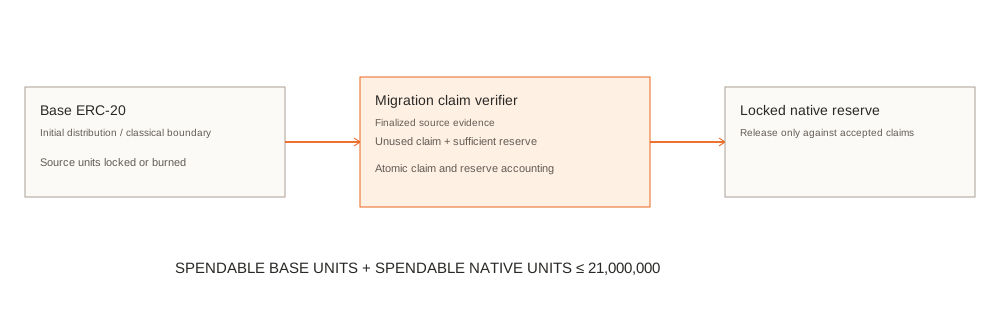
Only simultaneously spendable economic units belong in this sum. A release requires finalized source evidence, an unused claim identifier and sufficient locked reserve. The claim marker and reserve accounting update atomically.
The native reserve would be an initial genesis allocation, not permission for unrestricted later issuance.
The bridge design is not settled
Migration must prove that source units were irreversibly locked or burned, verify that proof on the destination and establish the recipient's new ownership.
| Approach discussed | Questions it introduces |
|---|---|
| Snapshot-based airdrop | Cutoff height, omitted holders, replay and prevention of duplicate economic spending. |
| Live burn-and-redeem | Source proof verification, reorganizations, ongoing custody and replay risk. |
| Locked native genesis reserve | Finalized claim verification, unused markers, reserve conservation and exceptional recovery behavior. |
Migration testing must cover pauses, competing claims, partial burns, lost keys and bridge compromise. A trustless Base verification mechanism has not been completed.